by Ben Mapp
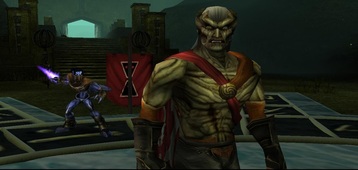
It was revealed early last year that Square Enix is at long last refilling the veins of the long dormant Legacy of Kain. The series itself has an extensive and complex overarching storyline which isn’t easy to follow, but let me try and quickly summarise it for the uninitiated. The series is set within the fictional fantasy setting of Nosgoth where the vampire Kain is chosen by divine forces as the ‘Scion of Balance’ and therefore the only person who can rid the land of its vast corruption. When Kain instead chooses to take over the world instead of purifying it, he forms an empire which – over millennia – contributes to immense corrosion of the landscape. Later, Kain regrets his decision and realises that the only way to undo Nosgoth’s fate is by travelling back in time to find a way to put things right without, preferably, sacrificing himself in the process. His odyssey leads him to create paradox after paradox, changing history as he does so, which then have their own negative effects on Nosgoth’s increasingly unstable timeline. Kain is pursued through time by Raziel, his former lieutenant, who believes that only Kain’s death will restore balance to the world.
It was revealed early last year that Square Enix is at long last refilling the veins of the long dormant Legacy of Kain. The series itself has an extensive and complex overarching storyline which isn’t easy to follow, but let me try and quickly summarise it for the uninitiated. The series is set within the fictional fantasy setting of Nosgoth where the vampire Kain is chosen by divine forces as the ‘Scion of Balance’ and therefore the only person who can rid the land of its vast corruption. When Kain instead chooses to take over the world instead of purifying it, he forms an empire which – over millennia – contributes to immense corrosion of the landscape. Later, Kain regrets his decision and realises that the only way to undo Nosgoth’s fate is by travelling back in time to find a way to put things right without, preferably, sacrificing himself in the process. His odyssey leads him to create paradox after paradox, changing history as he does so, which then have their own negative effects on Nosgoth’s increasingly unstable timeline. Kain is pursued through time by Raziel, his former lieutenant, who believes that only Kain’s death will restore balance to the world.
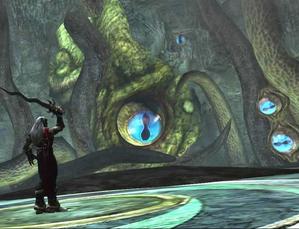
I missed out a lot of the finer details but you get the general idea. The beginning of Kain’s story was released in 1996 as Blood Omen: Legacy of Kain (designed by Silicon Knights for the original Playstation) and its success spawned four sequels. Arguably the most successful of these was Legacy of Kain: Soul Reaver (put together by a new design team at Crystal Dynamics). After its release in 1999, Legacy of Kain: Soul Reaver represented a bold step in 3D exploratory game-play and introduced co-protagonist Raziel into the fold. Eventually however Soul Reaver proved a hard act to follow and over time people lost interest in the progressively multifarious story. The series was ultimately abandoned in 2003 after the release of its last instalment Legacy of Kain: Defiance. A small, dedicated fan-base remained to safeguard the mythology until the time was right for the series to return, but then ten long years passed with no news of further development. In the interim, a couple of attempts to revive the series had started and failed under different studios as was discovered by anonymous Neogaf scholar ‘Mama Robotnik’, until finally – Psyonix Studios conceived a way for Square Enix (who now own the rights to the series) to invest without concerning themselves about the risk too much. As proven with their commitment to both the Final Fantasy and Tomb Raider brands, Square Enix would only spend money on something which was definitely going to offer a turnover whereas Legacy of Kain, with its still-dedicated fan-base and intricate storyline, posed a distinct risk.
After a decade-long break the concern was certainly understandable. Ultimately, the question was raised: could the latest generation of gamers be swooned by the dark world of vampires, humans and time-travel which this series has based its very foundations on? Psyonix Studios believed so without question, but understood that amendments would have to be made in order to continue the series in a more accessible way than had been done before. The first thing to be discarded therefore was the time-travel element. This meant that Psyonix’s Legacy of Kain game would inhabit a more stable and consistent world, as was the case in both Legacy of Kain: Soul Reaver and Legacy of Kain: Blood Omen 2. And so, as a result of Psyonix’s resolve not just to resurrect this series but also make it accessible for old and new fans alike, they daringly decided to create a game set firmly within the established canon of the series. You could argue it would have been easier to start again from scratch with a total reboot, but there was likely an understanding that this would have angered many of the life-long fans. Not only that, but many members of Psyonix’s staff are huge fans of the Legacy of Kain mythology, and so it was a personal thing for those fans to see this through without negating what had come before. Psynoix chose to keep things just distant enough from the more complex strands of the Legacy of Kain storyline in order to retain creative control without simply diminishing the previously established in-game histories. Kain and Raziel, who had led the major story arcs of the previous games, would not be making any appearances here. This game would be a separate branch which still adhered to the established canon but inhabited its own spectrum of the Legacy of Kain universe.
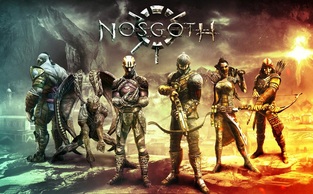
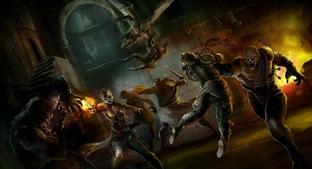
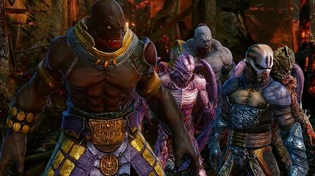
The result of all this is simply called ‘Nosgoth’, named after the fantasy setting of the series. Nosgoth takes place between the intro of Legacy of Kain: Soul Reaver (where we witness Kain first cast Raziel into the abyss), and the actual gameplay of Legacy of Kain: Soul Reaver (where Raziel finally awakens in the spectral realm). In the millennium between Raziel’s death as a vampire and resurrection as a wraith, unknown to us, a terrible war broke out across the world. After centuries of oppression, the human subjects finally chose to revolt against their vampiric overlords utilising the ancient technology and skills of their ancestors. As a result many humans became competent vampire hunters, presenting a new threat to the servants of Kain’s empire. This was a surprise move and caught the ruling vampire clans off-guard, resulting in humans killing vampires for the first time in centuries.The vampire hordes, ruled by Raziel’s former brethren, reacted by uniting against these seditious humans and putting together an army comprised of vampiric breeds representative of the individual strengths of each vampire clan. And so, with both sides at full strength, the war raged across the land. This war for Nosgoth is the centre-piece for the new game, which defies the game-play of the previous titles in the series. Instead Psyonix proposes a free-to-play, team-based, player-versus-player model which, until they say otherwise, will be exclusively available on Steam for PC users.
Whilst the first announcement was met with reasonable controversy, especially when taking into account how enormously different this entry in the series was going to be from its predecessors; Nosgoth represents an audacious new step for this series and could – potentially – set out a precedent for the resurrection of long dead gaming series’ in general. Over the last ten years as console generations passed, the console war widened into the mainstream and the different gaming genres have started to thin. Like the major Hollywood studios it seems that the major production studios are only interested in which game will become the next genre-defining title and will not invest in something which poses too much of a risk in the modern market. This is one reason why Square Enix would not invest in a new single-player adventure for Kain, at least not yet.The Legacy of Kain series has sat untouched and untested for over a decade, and it is therefore unknown how the modern gaming audience would react to a new release. Any developers hoping to get a new main instalment published will be stumbling into the market blind, risking the integrity and even potentially the continued success of their studio. This was the case with the ill-fated Kingdoms of Amalur: Reckoning (published by Big Huge Games and 38 Studios) which, despite the overwhelming praise it received upon release, was a financial bomb and actually led to the bankruptcy of both studios.
The fantasy genre is still as popular as ever but the success rate of its games has changed much since 2003. If a series is already popular then it is expected from the offset to produce a successful game (such as the Grand Theft Auto series), whereas a series which was less popular would not. The popularity and reputation of the development studios alone (such as Rockstar North for the previous example) could contribute to the success of the new game. For example 2011 saw the release of The Elder Scrolls V: Skyrim (by Bethesda Studios), a dark fantasy game set in the already largely-established world of Tamriel, which (because of its story, scope and epic size) turned out to be a monumental success. This was of course no surprise considering the successes of both of its direct predecessors, Morrowind and Oblivion, and so lots of money when into both producing the game and marketing it for the latest generation of gamers. But Elder Scrolls has been an intellectual property of Bethesda Studios for many years and they have put time and effort into refining that gaming experience over the course of their games. The gigantic span of each title alone shows that the developers as Bethesda wield ultimate creative control over the series. 2009 saw the release of a newcomer to the dark fantasy genre with Dragon Age: Origins (by Bioware) who – thanks to their successes with previous licensed RPG’s (such as the Mass Effect franchise) – were able to gain a success partially because of their reputation as a studio.
(Check back this Friday for Part 2! - Ed)
(Check back this Friday for Part 2! - Ed)

 RSS Feed
